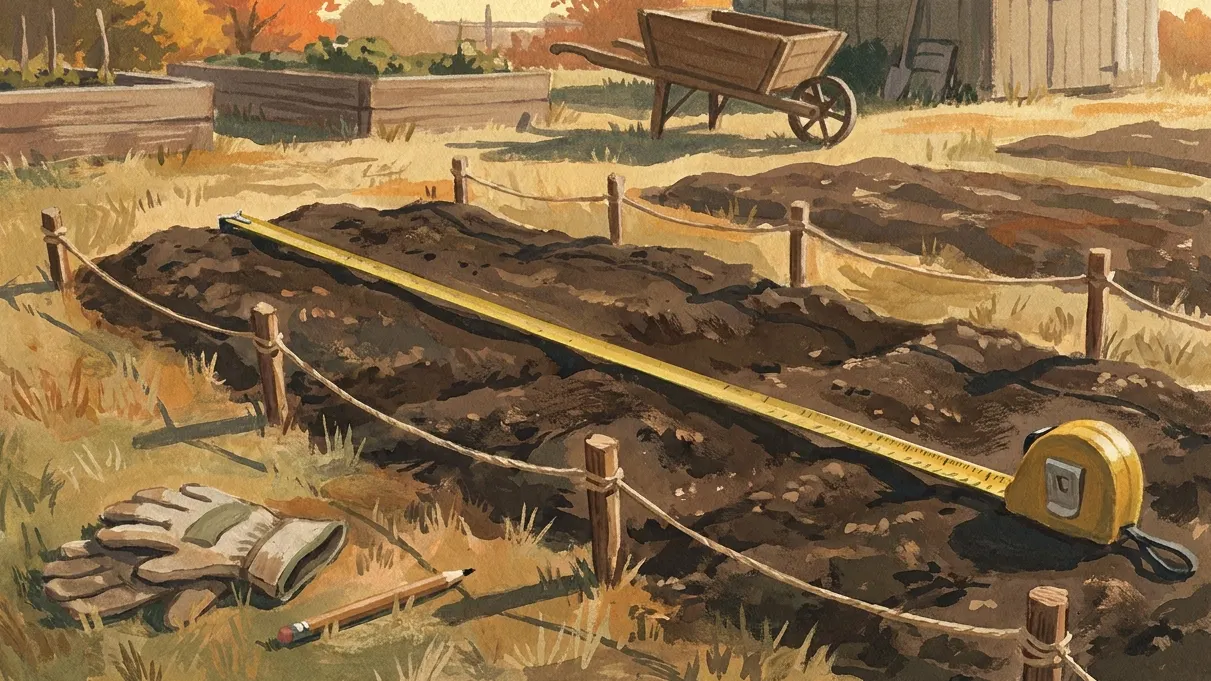
What you need
- A tape measure, ideally 25 ft or longer. A long garden tape helps for big beds.
- A ruler, for checking the depth of old mulch.
- Something to write on. A rough sketch of the beds with the numbers next to each one saves trips back outside.
Step 1: Measure each bed in feet
Rectangles and squares
Measure the long side and the short side. Multiply. A 24 ft × 4 ft strip along a fence is 96 sq ft.
Circles
Measure straight across the middle: that’s the diameter. Square footage = 3.1416 × diameter × diameter ÷ 4. A circle 6 ft across is 28.3 sq ft; 10 ft across is 78.5 sq ft.
Rings around trees
Measure the outer diameter of the ring and the bare circle you’ll leave at the trunk. Area = 3.1416 × (outer² − inner²) ÷ 4. An 8 ft ring with a 1 ft bare circle is 49.5 sq ft. The calculator has a “Ring around a tree” shape that does this for you.
Triangles and corner beds
Measure the two sides that meet at the square corner. Area = side × side ÷ 2. A corner bed 6 ft along each fence is 18 sq ft.
Curved and kidney-shaped beds
Pick one of these methods:
- Average width. Measure the length along the middle of the bed. Then measure the width at three to five evenly spaced points and average them. Length × average width.
- Split it up. Break the bed into a rectangle plus a half circle at each rounded end, or a few rectangles. Add the pieces.
- Garden hose outline. Lay a hose around the edge, then straighten it beside a tape to get the perimeter. This is handy for edging and landscape fabric, but not for area on its own.
The average-width method is accurate to within a few percent on most beds, which is less than the difference between one bag size and the next.
Step 2: Add up the square feet
Write each bed’s area on your sketch and total them. If one bed gets a different depth (a pathway of wood chips at 4 inches, say), keep it separate.
Step 3: Measure the depth you’ll add
For a new bed, decide on a depth: 2–3 inches for most mulch, 3–4 inches for coarse nuggets or wood chips. For a top-up, measure what is already there:
- Push a ruler down through the mulch until it stops at soil.
- Check four or five spots, including the edges, where mulch thins first.
- Subtract the average from your target. If 1 inch remains and you want 3, you’re adding 2.
Step 4: Convert to cubic yards
cubic yards = total square feet × depth (in) ÷ 324
Example: three beds of 96, 49.5 and 120 sq ft make 265.5 sq ft. At 3 inches: 265.5 × 3 ÷ 324 = 2.46 cubic yards, which you’d round up to 2.5 yards for a bulk order. In 2 cu ft bags, that’s 265.5 × 3 ÷ 12 = 66.4 cu ft ÷ 2 = 34 bags.
Measurements to cubic yards at a glance
| Bed | Square feet | Yards at 2 in | Yards at 3 in | Yards at 4 in |
|---|---|---|---|---|
| 10 × 3 ft | 30 | 0.19 | 0.28 | 0.37 |
| 20 × 4 ft | 80 | 0.49 | 0.74 | 0.99 |
| 30 × 5 ft | 150 | 0.93 | 1.39 | 1.85 |
| 40 × 6 ft | 240 | 1.48 | 2.22 | 2.96 |
| 6 ft circle | 28.3 | 0.17 | 0.26 | 0.35 |
| 10 ft circle | 78.5 | 0.48 | 0.73 | 0.97 |
Tips that make the numbers better
- Measure the bed, not the whole yard. Skip lawn, paths and patios.
- Leave out big obstacles. A 3 × 3 ft boulder or a 4 ft round water feature takes up real space; subtract it.
- Don’t subtract small plants. Shrubs and perennials take up little room at ground level.
- Slopes need a bit more. Mulch drifts downhill on slopes, so add 5–10%.
- Write units down. Most mistakes come from mixing inches and feet.
Once you have your square feet, put them into the mulch calculator (choose “I know the square feet”) or read the coverage chart to see what one yard or one bag covers.
Questions people ask
- How do you measure for mulch in yards?
- Measure the bed's length and width in feet and multiply them for square feet. Multiply square feet by the depth in inches and divide by 324. The result is cubic yards.
- How do I measure a curved bed?
- Measure the length along the middle of the curve, then measure the width every few feet and average those widths. Length × average width gives a close square-foot figure.
- How do I measure the depth of existing mulch?
- Push a ruler or a pencil marked in inches straight down until it hits soil, in four or five spots. Average the readings and subtract from the depth you want to end up with.
- Do I measure in feet or inches?
- Measure length and width in feet and depth in inches. The ÷ 324 formula expects exactly that mix. If you measured in inches, divide by 12 to get feet first.
- Can I measure with my phone?
- Phone measuring apps and online satellite maps are fine for a rough figure on big beds. For small beds a tape measure is quicker and more accurate.