The short answer
cubic yards = square feet × depth (in) ÷ 324
cubic feet = square feet × depth (in) ÷ 12
2 cu ft bags = cubic feet ÷ 2, rounded up
Run your numbers through the mulch calculator if you’d rather not do it by hand. It handles several beds at once, circles and tree rings, and shows bags and bulk side by side.
Step by step
- Measure each bed in feet. Length and width for rectangles, the diameter for circles. Round to the nearest half foot; more precision doesn’t change the order. The measuring guide covers curved and odd-shaped beds.
- Work out square feet. Length × width. For a circle, 3.1416 × diameter × diameter ÷ 4. Add up all the beds.
- Pick a depth. Usually 2–3 inches for beds, 3–4 inches for coarse nuggets or wood chips, and less if old mulch is still there. See how deep mulch should be.
- Multiply and divide. Square feet × inches ÷ 324 = cubic yards.
- Round up to what you can buy. Bulk usually comes by the half or whole yard; bags come in whole bags.
Worked example 1: a front foundation bed
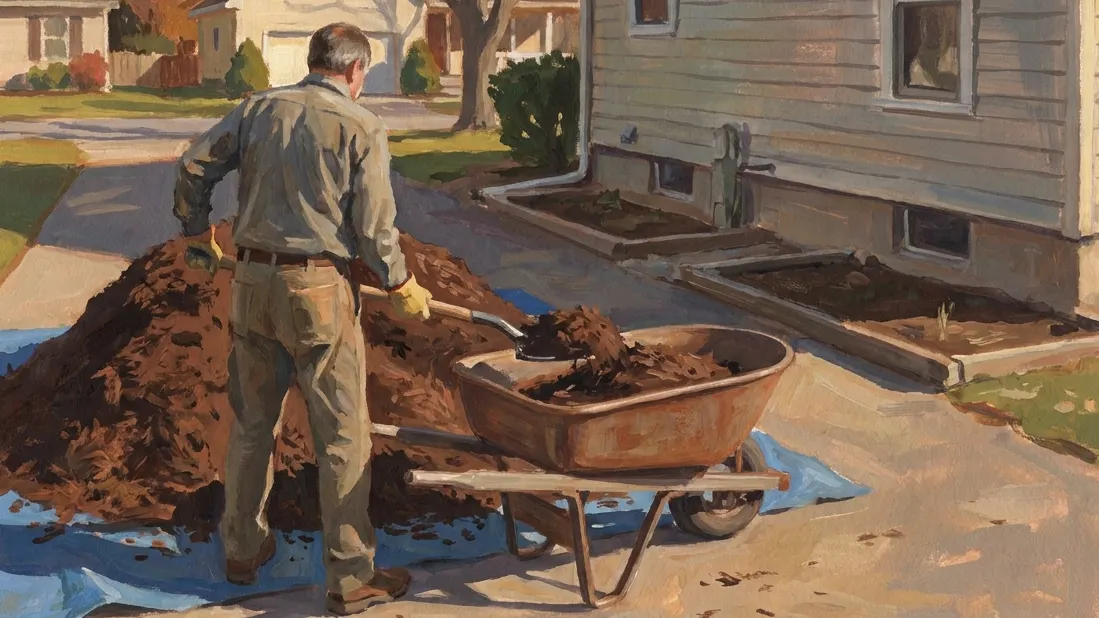
A bed along the front of the house is 36 ft long and 5 ft deep. You want 3 inches.
- 36 × 5 = 180 sq ft
- 180 × 3 ÷ 324 = 1.67 cubic yards → order 2 yards bulk
- 180 × 3 ÷ 12 = 45 cu ft → 45 ÷ 2 = 22.5 → 23 bags of 2 cu ft
Worked example 2: a top-up
The same bed still has about 1 inch of last year’s mulch, and you want to get back to 3 inches. You only need to add 2 inches:
- 180 × 2 ÷ 324 = 1.11 cubic yards
- 180 × 2 ÷ 12 = 30 cu ft → 15 bags
Topping up is where most people over-order. Push a ruler down through the old mulch to the soil in a few spots before you buy.
Worked example 3: an island bed with a circle
An island bed is a 12 × 8 ft rectangle with a round end 8 ft across. Treat the round end as half a circle.
- Rectangle: 12 × 8 = 96 sq ft
- Half circle: 3.1416 × 8 × 8 ÷ 4 ÷ 2 = 25.1 sq ft
- Total: 121.1 sq ft
- At 3 inches: 121.1 × 3 ÷ 324 = 1.12 cubic yards, or 30.3 cu ft = 16 bags
Worked example 4: rings around three trees
Three young trees each get a ring 6 ft across, with a 1 ft bare circle at the trunk so mulch doesn’t touch the bark.
- One ring: 3.1416 × (6² − 1²) ÷ 4 = 3.1416 × 35 ÷ 4 = 27.5 sq ft
- Three rings: 82.5 sq ft
- At 3 inches: 82.5 × 3 ÷ 324 = 0.76 cubic yards, or 20.6 cu ft = 11 bags
Quick reference
| Area | 2 in deep | 3 in deep | 4 in deep |
|---|---|---|---|
| 50 sq ft | 0.31 yd · 5 bags | 0.46 yd · 7 bags | 0.62 yd · 9 bags |
| 100 sq ft | 0.62 yd · 9 bags | 0.93 yd · 13 bags | 1.23 yd · 17 bags |
| 150 sq ft | 0.93 yd · 13 bags | 1.39 yd · 19 bags | 1.85 yd · 25 bags |
| 250 sq ft | 1.54 yd · 21 bags | 2.31 yd · 32 bags | 3.09 yd · 42 bags |
| 400 sq ft | 2.47 yd · 34 bags | 3.70 yd · 50 bags | 4.94 yd · 67 bags |
| 750 sq ft | 4.63 yd · 63 bags | 6.94 yd · 94 bags | 9.26 yd · 125 bags |
Bags are 2 cu ft, rounded up. For other bag sizes, see the mulch bag calculator.
How much to buy, and how much to order extra
- Bulk: round up to the next half yard. Most landscape yards load with a bucket that holds a set amount, and some have a minimum delivery. Ask before you order.
- Bags: round up to the next whole bag, then consider one or two spare. Unopened bags keep for touch-ups.
- Extra: if the beds are sloped, the edges are fuzzy, or you’re filling a low spot, add 5–10%. Otherwise, rounding up is usually enough.
Common mistakes
- Using the whole yard instead of the beds. Only measure the planted area that gets mulch, not the lawn around it.
- Forgetting the units. Depth must go in as inches in the ÷ 324 formula, but as feet (inches ÷ 12) if you are working in cubic feet.
- Mixing up square yards and cubic yards. Mulch is sold by the cubic yard, a volume. A square yard is 9 square feet of area.
- Piling it too deep. More than 4 inches can keep water and air from reaching roots. The depth guide explains why.
These figures assume loose mulch measured the way suppliers sell it. If a product's bag lists its own coverage, trust the bag.
Questions people ask
- What is the formula for mulch?
- Cubic yards = square feet × depth in inches ÷ 324. For cubic feet, use square feet × depth in inches ÷ 12. For 2 cubic foot bags, divide the cubic feet by 2 and round up.
- How much mulch do I need for 100 square feet?
- At 3 inches deep, 100 square feet needs 25 cubic feet: 0.93 cubic yards or 13 bags of 2 cubic feet. At 2 inches it needs 0.62 cubic yards or 9 bags.
- How much mulch do I need for 1,000 square feet?
- About 6.2 cubic yards at 2 inches, 9.3 cubic yards at 3 inches and 12.3 cubic yards at 4 inches.
- How do I figure mulch for an odd-shaped bed?
- Split it into rectangles, circles and triangles, work out each area and add them, or measure the longest length and the average width. The calculator lets you add each piece as a separate bed.
- Do I need to account for plants already in the bed?
- Not usually. Shrub bases take up little volume, and the space you skip around stems roughly balances the mulch that settles. Large boulders or a patio inside the bed area should be measured and left out.