Recommended mulch depth by type
| Mulch | Depth | Why |
|---|---|---|
| Shredded hardwood, cedar, cypress | 2–3 in | Strands knit together and block light well |
| Pine bark fines / mini nuggets | 2–3 in | Small pieces pack tightly |
| Large pine bark nuggets | 3–4 in | Gaps between nuggets let light through |
| Wood chips | 3–4 in | Coarse and airy; settles over time |
| Dyed mulch | 2–3 in | Same as the wood it’s made from |
| Pine straw | 2–3 in settled | Goes down fluffy, settles within weeks |
| Rubber mulch (beds) | 1.5–2 in | Heavy, doesn’t break down |
| Playground loose fill | 9–12 in | Safety surface; see the playground calculator |
Why depth matters
Too thin (under about 2 inches) and light reaches the soil, so weed seeds sprout and the soil dries out faster.
Too deep (well over 4 inches in beds) and the layer can shed water before it reaches the roots, keep the soil from breathing, and give rodents a place to nest. Deep, wet mulch against bark also invites rot.
About right keeps moisture in, keeps weeds down, softens temperature swings and slowly adds organic matter as it breaks down.
Mulching around trees
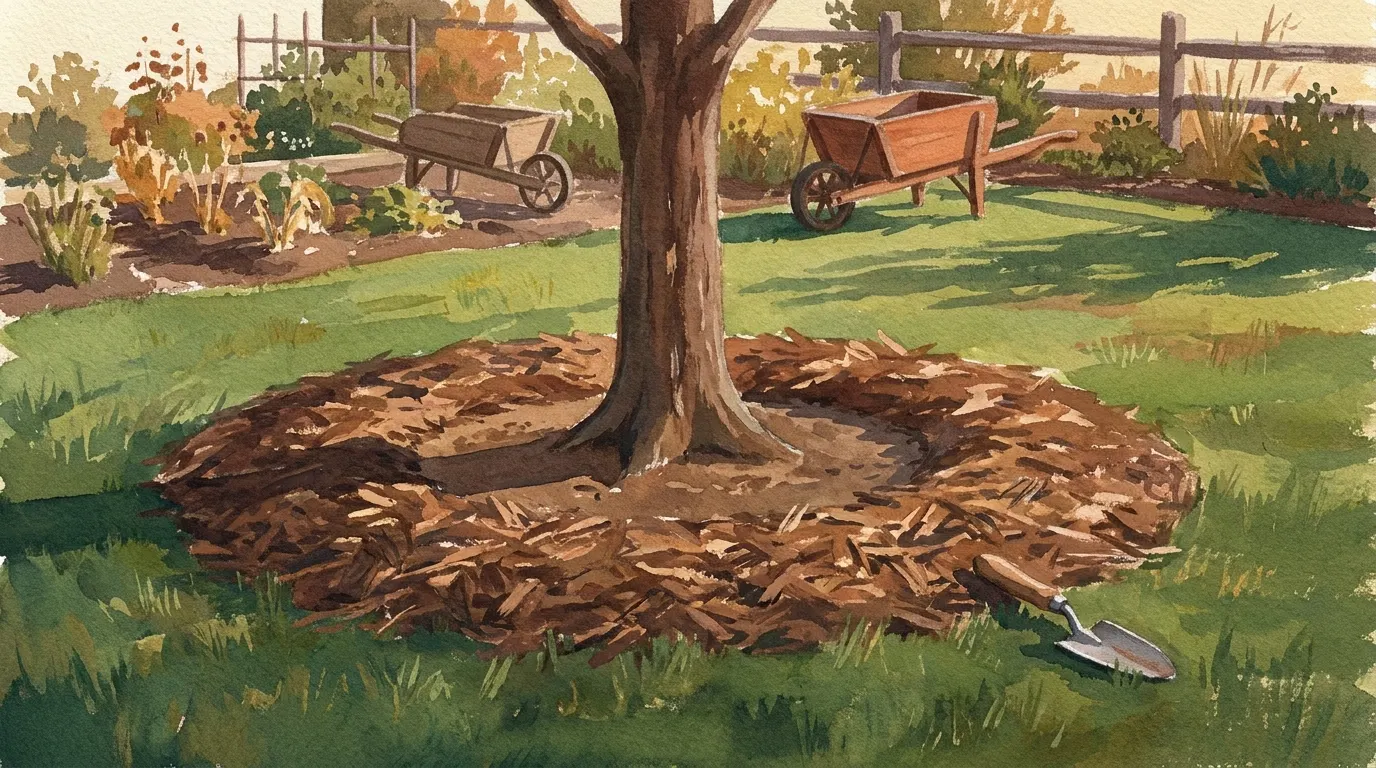
A wide, flat ring is better than a tall cone. When mulch gets piled against the trunk (a mulch “volcano”), it holds moisture against the bark and can lead to decay and girdling roots.
- Clear grass from a circle around the tree. Wider is better; out toward the drip line is ideal, but even a 3–4 ft circle helps a young tree.
- Spread mulch 2–4 inches deep across the ring.
- Pull it back a few inches from the trunk so the root flare, where the trunk widens at the base, stays visible.
The calculator’s Ring around a tree shape handles the bare circle at the trunk. For a ring 6 ft across with a 1 ft bare center at 3 inches, you need about 6.9 cubic feet: 0.25 cubic yards, or 4 bags of 2 cu ft. At 4 inches, 0.34 yards or 5 bags.
Topping up vs starting fresh
Mulch breaks down from the bottom, so a 3 inch layer laid this spring may be 1–2 inches next spring. Before you buy:
- Push a ruler down through the mulch to the soil in a few places.
- Subtract the average from your target depth.
- Put only the difference into the mulch calculator.
For example, a 200 sq ft bed with 1.5 inches left needs 1.5 more inches to get back to 3: 200 × 1.5 ÷ 324 = 0.93 cubic yards, not the 1.85 a fresh 3 inch layer would take.
How often to replace mulch
- Shredded wood mulch: top up every year or two.
- Dyed mulch: often topped up yearly, mostly for color.
- Bark nuggets and cedar: often last longer between top-ups.
- Pine straw: usually refreshed once or twice a year.
- Rubber mulch: doesn’t break down; just rake it back into place and add some where it thins.
If old mulch has matted into a crust that sheds water, break it up with a rake or remove it before adding more.
Depth vs quantity
Every inch matters for your order. On 100 sq ft:
| Depth | Cubic yards | 2 cu ft bags |
|---|---|---|
| 1 inch | 0.31 | 5 |
| 2 inches | 0.62 | 9 |
| 3 inches | 0.93 | 13 |
| 4 inches | 1.23 | 17 |
Going from 3 to 4 inches adds a third more mulch. That’s worth it for chunky nuggets and chips, but not for fine mulch that’s already doing its job at 3.
These are general guidelines. Local extension offices often publish mulching advice for your climate and soil, and they're worth a look for specific plants.
Questions people ask
- How deep should mulch be in flower beds?
- About 2 to 3 inches. Finer mulch can be closer to 2 inches; chunkier mulch closer to 3. Around small annuals and seedlings, an inch or two is enough.
- Can mulch be too deep?
- Yes. Much more than 4 inches in beds can keep water and air from reaching the soil, and mulch piled against trunks and stems holds moisture against the bark and invites rot and pests.
- How much mulch should go around a tree?
- Spread a flat ring 2 to 4 inches deep, as wide as practical (out toward the drip line is ideal), and pull it back a few inches from the trunk so the flare at the base shows. Avoid a cone-shaped mulch volcano.
- How often should I replace mulch?
- Most wood mulch needs a top-up every year or two as it breaks down. Check the depth each spring and add just enough to get back to 2 to 3 inches. There is rarely a need to remove old mulch unless it has matted into a crust.
- Should I remove old mulch before adding new?
- Usually not. Rake old mulch to loosen it, then add only enough new mulch to reach the target depth. Remove it if it's packed into a water-shedding mat, moldy or far too deep.