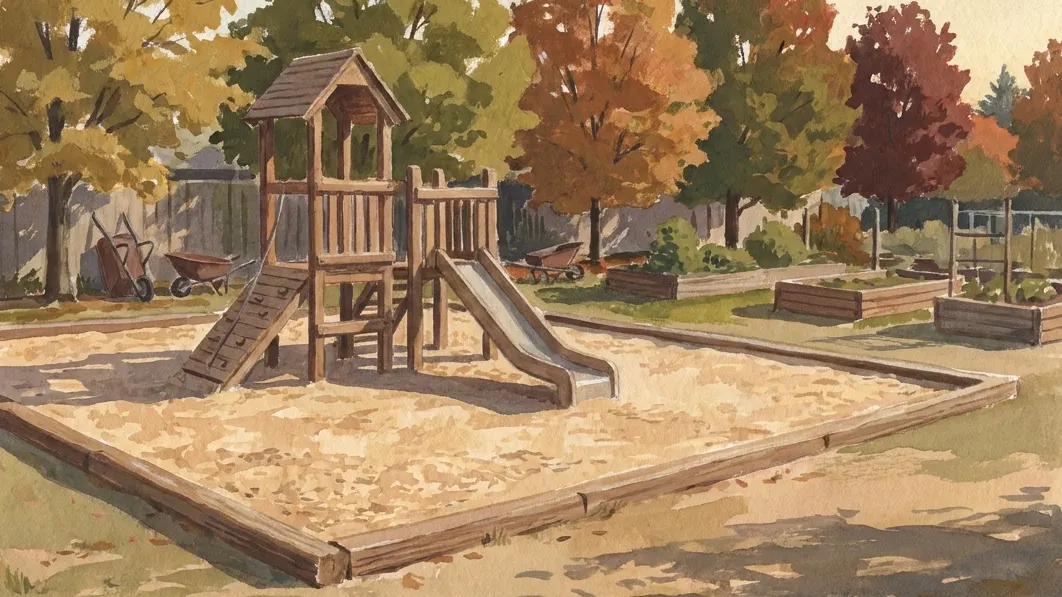
Step 1: Measure the use zone, not just the equipment
The surfacing has to cover everywhere a child might fall. The CPSC handbook calls this the use zone, and for most equipment it extends at least 6 feet in every direction from the edge of the equipment. Swings need more room in front and behind, and slides need room at the exit; check the handbook or the equipment manual for those.
Example: a play structure with a footprint of 18 × 12 ft needs a surfaced area of at least (18 + 6 + 6) × (12 + 6 + 6) = 30 × 24 ft, or 720 sq ft. That’s the default in the calculator above.
Step 2: Choose the depth
The U.S. Consumer Product Safety Commission’s Public Playground Safety Handbook lists the minimum compressed depths for loose fill:
| Material | Depth (compressed) | Protects to a fall height of |
|---|---|---|
| Shredded/recycled rubber | 6 in | 10 ft |
| Wood chips | 9 in | 10 ft |
| Wood mulch (not CCA-treated) | 9 in | 7 ft |
| Pea gravel | 9 in | 5 ft |
| Sand | 9 in | 4 ft |
The same handbook says:
- Loose fill compresses at least 25% over time, so if you need 9 inches of wood chips, fill to 12 inches.
- Never use less than 9 inches of loose fill, except shredded/recycled rubber (6 inches recommended).
- Engineered wood fiber and playground rubber products should be tested to ASTM F1292; follow the manufacturer’s depth for the fall height of your equipment.
Step 3: Calculate
cubic yards = square feet × depth (in) ÷ 324
For the 30 × 24 ft example:
- At 12 inches of wood chips or fiber: 720 × 12 ÷ 324 = 26.7 cubic yards (720 cu ft)
- At 6 inches of rubber: 720 × 6 ÷ 324 = 13.3 cubic yards (360 cu ft)
Quantities like this are bulk deliveries. Bagged mulch at 2 cu ft would mean 360 bags for the wood-chip version.
Playground surfacing quantities
| Surfaced area | 12 in wood fill | 9 in wood fill | 6 in rubber |
|---|---|---|---|
| 16 × 16 ft (256 sq ft) | 9.5 yd | 7.1 yd | 4.7 yd |
| 20 × 20 ft (400 sq ft) | 14.8 yd | 11.1 yd | 7.4 yd |
| 24 × 24 ft (576 sq ft) | 21.3 yd | 16.0 yd | 10.7 yd |
| 30 × 24 ft (720 sq ft) | 26.7 yd | 20.0 yd | 13.3 yd |
| 30 × 30 ft (900 sq ft) | 33.3 yd | 25.0 yd | 16.7 yd |
Use the 12 inch column for a new wood-fill installation. Use 9 inches only if you’re topping up a surface that has already settled.
Choosing a playground surface
- Engineered wood fiber (EWF). Made for playgrounds, knits together underfoot, and can be firm enough for wheelchair access when installed and maintained to the manufacturer’s spec.
- Wood chips. Widely available and inexpensive. Make sure they’re clean, without treated or painted wood and without lots of sticks or debris.
- Rubber mulch. Shallower depth, doesn’t decompose, and doesn’t compress like wood. Choose a product sold for playgrounds and tested to ASTM F1292. See the rubber mulch calculator.
- Not suitable: grass, dirt, concrete and asphalt aren’t protective surfacing. The handbook also advises against loose fill for playgrounds meant for toddlers.
Keeping it safe
- Contain it. A timber or plastic border keeps the fill in place.
- Mark the fill line. Paint a line on a post at the right depth so you can see when it’s low.
- Rake it back. Swings and slide exits dig holes fast. Rake fill back into them weekly in busy seasons, or install wear mats there.
- Drain it. Standing water speeds compaction and decay.
- Top up. Wood fill breaks down and gets carried off. The wood chip calculator handles top-up orders.
The depths here come from the CPSC Public Playground Safety Handbook, which is written for public playgrounds and is a sensible guide for backyard sets too. Always follow the equipment manufacturer's and the surfacing manufacturer's instructions, and use the stricter figure.
Questions people ask
- How much mulch do I need for a playground?
- Measure the whole use zone, which is the equipment plus at least 6 feet on every side, then multiply square feet by depth in inches and divide by 324. A 30 × 24 ft area at 12 inches needs about 26.7 cubic yards.
- How deep should playground mulch be?
- The CPSC's Public Playground Safety Handbook says never to use less than 9 inches of loose-fill material, except shredded or recycled rubber, where it recommends 6 inches. Because wood fill compresses at least 25 percent, it recommends filling to 12 inches to keep 9.
- What is engineered wood fiber?
- Engineered wood fiber, or EWF, looks like landscape mulch but is made specifically as a playground surface. It should meet ASTM F2075 and be tested to the ASTM F1292 impact standard. Use the manufacturer's recommended depth.
- Can I use regular landscape mulch under a swing set?
- The CPSC handbook lists wood mulch and wood chips as loose-fill options, provided the wood isn't CCA-treated and the depth is maintained. Avoid mulch made from wood of unknown origin, and avoid dyed mulch if you don't know what's in it.
- Why does playground mulch need topping up?
- Loose fill gets kicked out from under swings and slide exits, and wood fill compresses and breaks down. Check the depth regularly and refill high-traffic spots.