How many wood chips do you need?
cubic yards = square feet × depth (in) ÷ 324
Worked example: a garden path
A path 40 ft long and 3 ft wide, 4 inches deep:
- 40 × 3 = 120 sq ft
- 120 × 4 ÷ 324 = 1.48 cubic yards (40 cu ft)
- Round up to 1.5 yards for a bulk order
Worked example: paths between raised beds
Four paths, each 16 × 2 ft, at 3 inches:
- 4 × 16 × 2 = 128 sq ft
- 128 × 3 ÷ 324 = 1.19 cubic yards (32 cu ft)
Enter each path as its own bed in the calculator, or add them up and use “I know the square feet”.
Wood chip coverage
| Cubic yards | At 3 in | At 4 in | At 6 in |
|---|---|---|---|
| 1 | 108 sq ft | 81 sq ft | 54 sq ft |
| 2 | 216 sq ft | 162 sq ft | 108 sq ft |
| 5 | 540 sq ft | 405 sq ft | 270 sq ft |
| 10 | 1,080 sq ft | 810 sq ft | 540 sq ft |
| 15 | 1,620 sq ft | 1,215 sq ft | 810 sq ft |
Where to use wood chips
- Paths. Chips are springy and drain well. Lay 3–4 inches over cardboard or landscape fabric to keep grass and weeds from coming through. The landscape fabric calculator counts rolls.
- Tree rings. A wide, flat ring 3–4 inches deep, pulled back from the trunk, is ideal. Use the “Ring around a tree” shape in the calculator.
- Shrub borders and natural areas. Chips look informal and last well.
- Play areas. Use clean, playground-grade chips at much deeper fill; see the playground mulch calculator.
Fresh chips vs aged chips
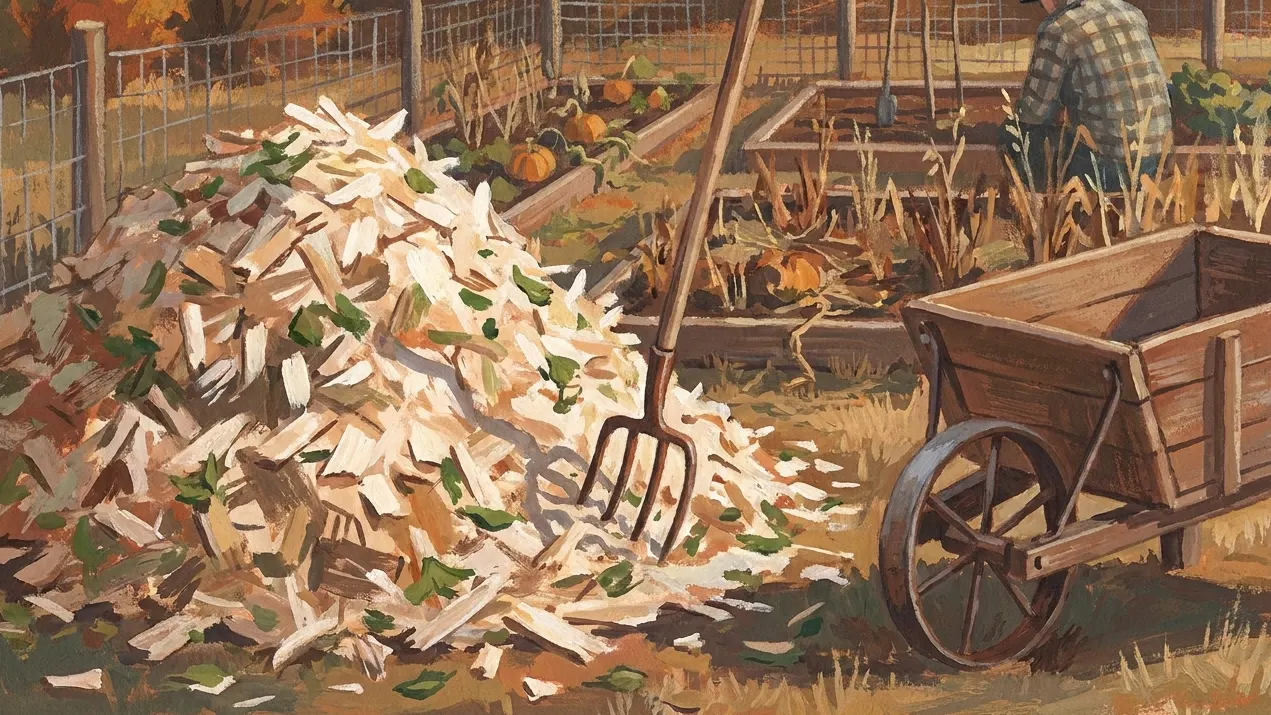
Fresh chips from tree work are often pale, may include green leaves, and can be very wet and heavy. They’re fine as a top mulch on paths and around established trees and shrubs. As they start to break down they tie up a little nitrogen right at the surface, so don’t dig them into planting beds.
Aged chips have darkened and settled. They’re a little lighter to move and blend in better in front beds.
Bulk loads of chips
Wood chips usually come in bulk. Tree services sometimes drop off chips from local jobs, and landscape yards sell them by the yard. If you’re getting a load from a tree crew:
- Ask how many yards their truck holds. A full chip truck can be much more than one yard, so make sure you have the space and a plan.
- Have them dump it close to where you’ll spread it, on a spot that won’t be damaged by the truck.
- Expect variety: leaves, needles and the odd bigger piece are normal.
- Spread it within a few weeks. Big piles can get hot in the middle as they start to break down.
Wood chips settle more than shredded mulch as the gaps close up, so a 4 inch layer may look closer to 3 after a season. That's normal; top up the paths that get the most traffic.
Questions people ask
- How many wood chips do I need?
- Square feet × depth in inches ÷ 324 = cubic yards. A 40 × 3 ft path at 4 inches is 120 × 4 ÷ 324 = 1.48 cubic yards.
- How deep should wood chips be?
- About 3 to 4 inches for beds, paths and tree rings. Paths that get heavy foot traffic can go a bit deeper. Playgrounds need much more; see the playground mulch calculator.
- How much does a yard of wood chips cover?
- About 108 square feet at 3 inches and 81 square feet at 4 inches.
- Do fresh wood chips steal nitrogen from plants?
- Only right at the surface where the chips touch the soil, as they start to break down. Used as a top layer, they don't rob plant roots below. Don't dig fresh chips into the soil.
- Are wood chips the same as mulch?
- Wood chips are one kind of mulch. They're chunkier and more varied than shredded landscape mulch, often include bark and leaves, and break down more slowly.