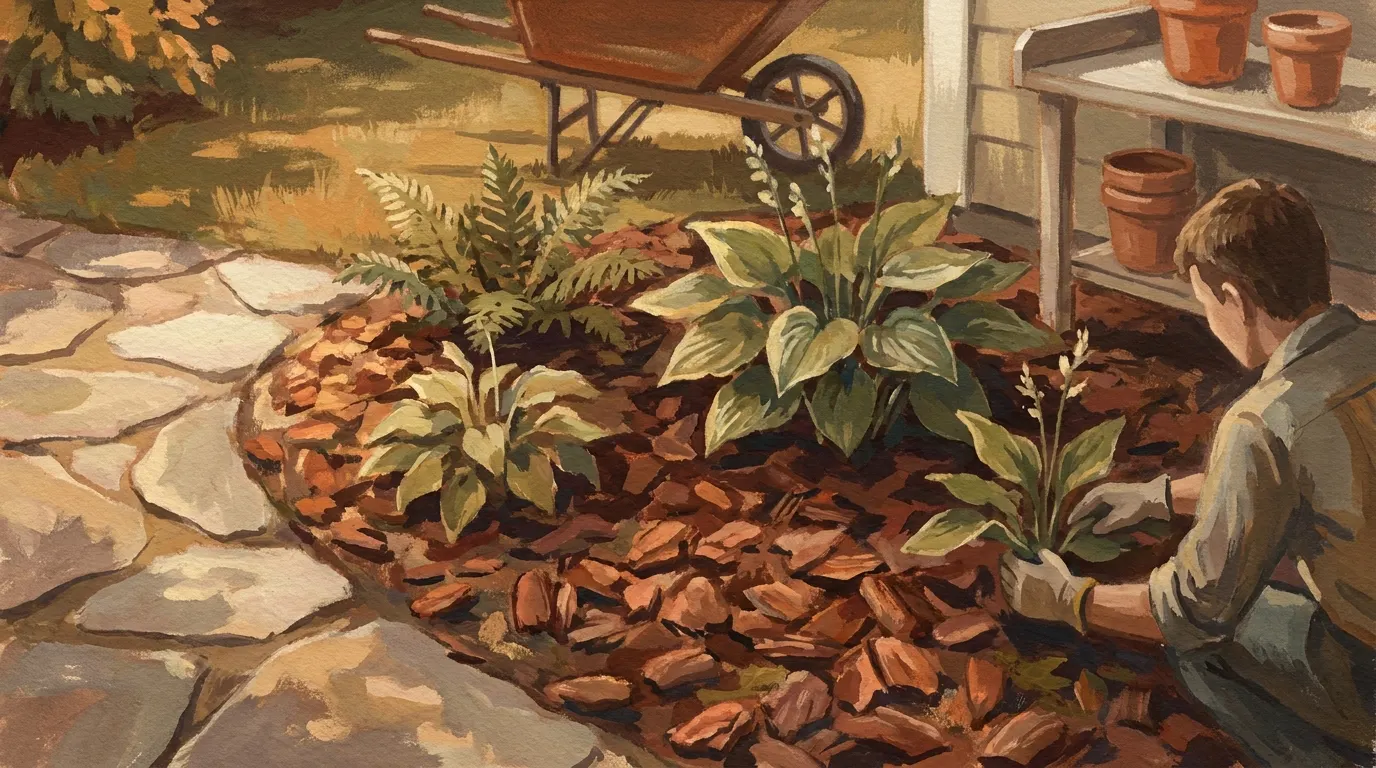
How much bark mulch do you need?
cubic yards = square feet × depth (in) ÷ 324
The formula is the same for every bark product. Size changes only the depth you choose.
Worked example
A shady bed is 15 × 8 ft and you’re using pine bark nuggets at 3 inches:
- 15 × 8 = 120 sq ft
- 120 × 3 ÷ 324 = 1.11 cubic yards
- 120 × 3 ÷ 12 = 30 cu ft → 15 bags of 2 cu ft or 10 bags of 3 cu ft
Change to 4 inches for big nuggets and it becomes 1.48 cubic yards (40 cu ft, 20 bags of 2 cu ft).
Bark sizes and how deep to lay them
| Bark product | Piece size | Depth | Best for |
|---|---|---|---|
| Large pine bark nuggets | Roughly 2–4 in chunks | 3–4 in | Flat beds, around trees and big shrubs |
| Medium / mini nuggets | Roughly 1/2–1.5 in | 2–3 in | Most beds, foundation plantings |
| Pine bark fines (soil conditioner) | Under about 1/2 in | 2–3 in | Perennials, small beds |
| Shredded bark | Stringy strands | 2–3 in | Slopes and beds; knits together |
| Bark dust (fir, hemlock) | Fine to medium grind | 2–3 in | Beds in the Pacific Northwest |
Size names aren’t standard between suppliers, so look at the product rather than the label. A useful test: if you can see soil between the pieces after spreading, go a bit deeper.
Bark mulch coverage
| Depth | Per cubic yard | Per 2 cu ft bag | Per 3 cu ft bag |
|---|---|---|---|
| 2 inches | 162 sq ft | 12 sq ft | 18 sq ft |
| 3 inches | 108 sq ft | 8 sq ft | 12 sq ft |
| 4 inches | 81 sq ft | 6 sq ft | 9 sq ft |
Bark dust: buying by the yard or the unit
In parts of the Pacific Northwest, bark dust is delivered in bulk, often by blower truck, and some suppliers quote by a “unit” rather than a yard. Units aren’t the same everywhere, so ask how many cubic yards a unit holds before you compare prices, then use the cubic feet to yards converter if you need it. Blown-in bark is spread straight into the beds, which saves the wheelbarrow work but usually costs extra.
Nuggets vs shredded bark
Nuggets look tidy, last a long time and let water straight through. They’re light, so heavy rain can wash them onto paths and lawns, especially on slopes or beside downspouts.
Shredded bark knits into a mat that stays put on slopes and blocks light at a shallower depth. It breaks down a little faster, so it adds organic matter to the soil sooner.
Fines look the neatest and suit small beds, but they break down quickest and need topping up more often.
Tips for a bark mulch bed
- Weed first and edge the bed so the bark has a clean line to sit against.
- On slopes, use shredded bark or pine straw instead of large nuggets.
- Keep bark a few inches back from trunks and stems.
- Top up only what’s needed. Check the existing depth with a ruler before you buy; the depth guide shows how.
Bark products vary by region: pine bark is most common in the South and East, fir and hemlock bark in the Northwest. Coverage depends only on volume and depth, so the calculator works for all of them.
Questions people ask
- How do I calculate how much bark mulch I need?
- Square feet × depth in inches ÷ 324 gives cubic yards. A 15 × 8 ft bed at 3 inches is 120 × 3 ÷ 324 = 1.11 cubic yards, or 30 cubic feet.
- How deep should bark nuggets be?
- Large nuggets about 3 to 4 inches, because the gaps between them let light through. Mini nuggets and fines about 2 to 3 inches.
- What is bark dust?
- Bark dust is the Pacific Northwest name for finely ground bark mulch, usually from fir or hemlock. It's spread 2 to 3 inches deep and calculated like any other mulch.
- Do pine bark nuggets float away?
- Large nuggets are light and can float in heavy rain, especially on slopes or near downspouts. Use shredded bark, fines or pine straw on slopes, and an edging to hold nuggets in flat beds.
- How many bags of bark mulch make a yard?
- 13.5 bags of 2 cubic feet, 9 bags of 3 cubic feet or 18 bags of 1.5 cubic feet.